← Back to blog Faro
Faro
2 Oct 2026
Coinbase Premium Index: Live Chart and How to Read It
FaroFaro
The Coinbase Premium Index measures the price difference for Bitcoin on Coinbase and Binance, making it one of the best reads on US institutional spot demands. When Coinbase trades higher, it shows that US buyers are paying for spot, and when it trades lower, it shows that they are selling or sitting out. The Premium Index is not a guaranteed buy or sell signal, and is more useful when combined with price and perp data.
This guide covers how the Coinbase Premium Index paired with Hyperliquid funding rates and Open Interest separates spot-led moves from leverage-led ones, making it easier to tell when a move has real buyers behind it or just borrowed momentum.
You can read a live Coinbase Premium Index as a gauge for US spot demand, not a standalone buy or a sell signal. A reading above zero means BTC trading is priced higher on Coinbase than on Binance, and a reading below zero means Coinbase is priced lower.
The Coinbase Premium Index measures how far Bitcoin’s price on Coinbase sits above or below its price on Binance. This is typically calculated as the difference between the BTC/USD price on Coinbase versus Binance, usually shown as a percentage or dollar value. If the reading is positive, it means that Coinbase is trading at a premium, and if it is negative it means that Coinbase is trading at a discount.
But why is the Coinbase Premium Index measured against Binance?
Put simply, Coinbase is the main on-ramp for US investors, and plays a central role in the spot Bitcoin ETF market, making Coinbase a useful gauge for ETF and institutional demand in the US. Binance is the global reference point, as it is the highest volume crypto exchange, and its BTC/USDT market reflects worldwide trading history. Comparing these two to each other isolates the US from the rest of the market.
The formula to calculate the Coinbase Premium is:
Premium Rate = Coinbase Spot - Binance Spot / Binance Spot x 100
For example, if Bitcoin trades at $100,200 on Coinbase and $100,000 on Binance, the premium is $200, or 0.20%,
The dollar gap between Coinbase and Binance scales with the price of BTC. The percentage gap normalizes for price, making it a better comparison across market cycles or between BTC and ETH.
Values can differ slightly between CoinGlass and CryptoQuant due to the methodology they use. Neither of the two data platforms fully publish details such as sampling frequency and timestamps which can lead to discrepancies.
The sign of the Coinbase Premium shows you which way spot demand in the US is leaning.
Premium tends to move during US trading hours, so a small reading, around +/-0.1%, can be seen as just noise. However, a premium that stays positive or negative for days says more, as it is not to just be read as a blip on the charts.
It is important to also read the direction of the change, as momentum often matters more than the sign. A move from -0.20% to -0.05% shows US demand is recovering even though the print is still showing as negative. Whereas a fall from +0.15% to +0.02% shows demand is fading despite the print showing as positive.
The ETH and BTC premium differ from each other. The ETH premium measures Ethereum’s price gap between Coinbase and Binance, just like Bitcoin’s but because Coinbase custodies most US spot Ethereum ETFs, it also tracks institutional demand. This differs from BTC as Ethereum’s market is thinner and its ETF flows are smaller, so a few large orders can move it. ETH also has demand that is not on Coinbase spot i.e. staking and DeFi.
When the two diverge, an ETH premium above BTC usually means money is rotating from Bitcoin to Ethereum. When the ETH premium is below BTC, it suggests capital is concentrating in Bitcoin or the demand for ETH is weaker.
Where the Coinbase Premium shows who is buying spot, Hyperliquid funding shows who is paying to hold the leveraged perp positions. When you read the two together, they separate moves with real buyers behind them from moves running on borrowed momentum.
Here is how the premium and funding pairs read:
| Funding flat | Funding high | Funding negative | |
| Premium positive | Spot-led, healthy. Buyers are paying up on Coinbase while perp traders stay neutral. Carries less liquidation risk. | Spot and leverage aligned, strong but not crowded. Spot buyers and perp longs are both pushing price up. | Shorts vs spot demand, squeeze risk. Buyers are lifting spot while perp traders bet against them. |
| Premium negative | Weak spot demand, low conviction. Buyers are absent and perp traders aren't leaning the way. | Leverage-led, fragile. Perp longs are paying heavily to hold positions while US spot demand is absent. | Broad risk-off. US spot demand is weak and perp traders are positioned for downside. |
When reading the chart, you should start with the premium so see whether US spot demand is present, then pair that with funding to see if leverage is leaning with it, or against it. You then check open interest to confirm whether leverage is building or unwinding behind the move.
Rising open interest alongside high funding confirms leverage is building, strengthening the reading. In a squeeze setup, rising open interest means more shorts are stacked and the squeeze has more fuel, whereas a sharp drop in open interest as price rises suggests shorts are already closing. In a healthy setup, a flat open interest supports the spot-led read, but if there is a sudden jump, then there is reason to question the read.
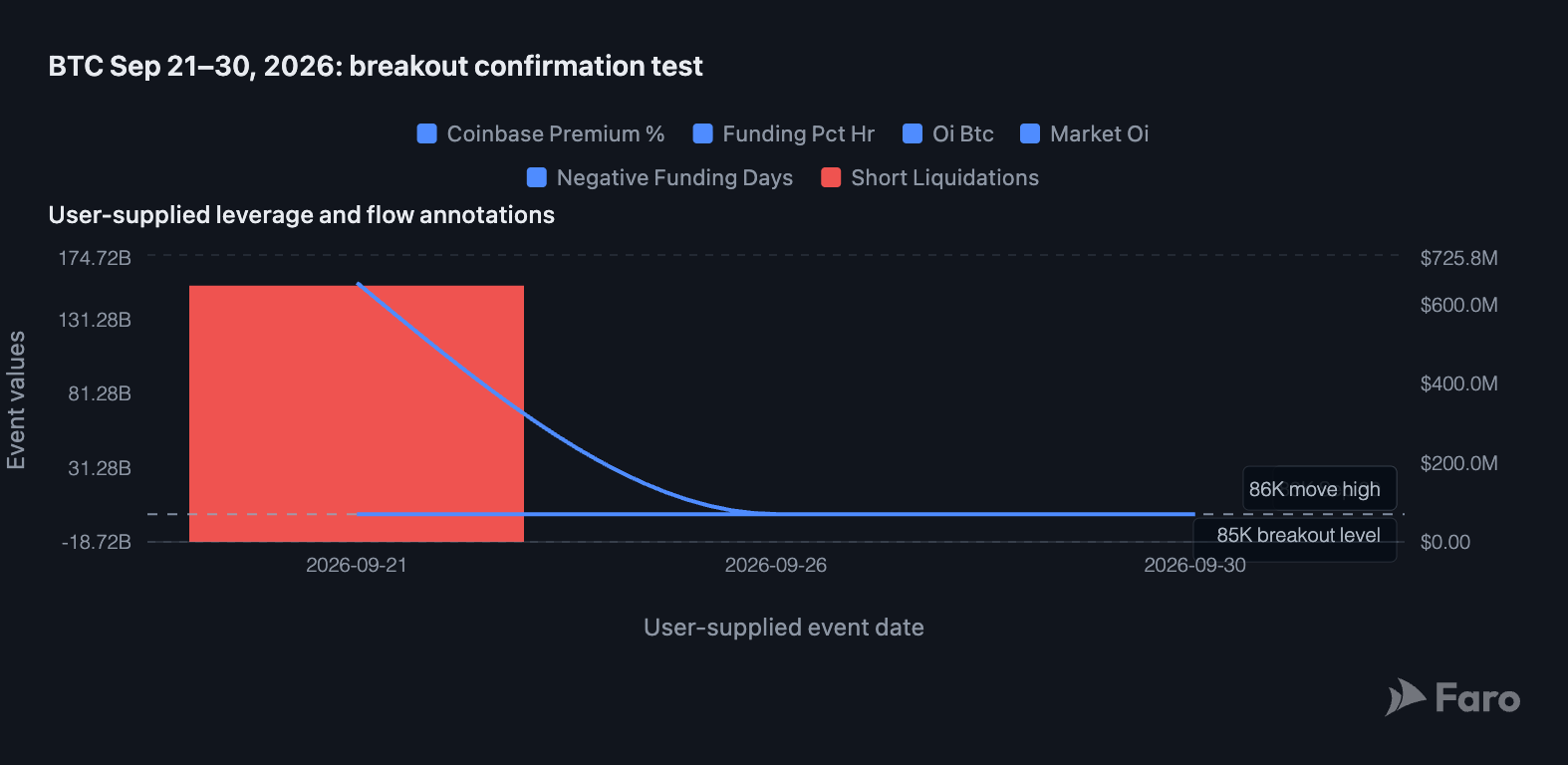
On September 21st, 2026, Bitcoin broke above $85K for the first time in over 8 months. Around $648M in short positions were liquidated, and market-wide open interest rose 7.59% to roughly $156B.
Despite Bitcoin nearing $86K, US spot buyers weren’t paying up on Coinbase. Hyperliquid funding sat at its baseline rate 0.00125% per hour suggesting that longs weren’t paying extra to hold their positions, even with open interest still rising. Even though there was no spot bid or funding stress, the leverage was still building, and it looked as if the move was driven by short-covering opposed to US buying.
By September 26th, 2026, CoinGlass showed four straight negative days, at -0.0082%. Bitcoin then slipped from $86k to $83k by September 30th, roughly 4% lower, while rising odds of a Fed rate hike also pushed crypto down.
Funding alone would have missed this move because it looked flat, and the premium showed no spot support despite open interest leverage building.
Since the Coinbase Premium is a price gap, it should not be used as a standalone signal, but rather a trend that is read alongside ETF flows and perp data.
The Premium has three main blind spots that can distort price:
FAQs
What is the Coinbase Premium Index in simple terms?
The Coinbase Premium Index measures how far Bitcoin’s price on Coinbase sits above or below its price on Binance
How is the Coinbase Premium calculated?
The formula to calculate the Coinbase Premium is:
Premium Rate = Coinbase Spot - Binance Spot / Binance Spot x 100
Is a positive Coinbase Premium bullish?
No, it does not automatically mean it is bullish. Since the premium factors in retail, and OTC and ETF flows together, a spike can happen from a short burst of buys, opposed to institutional accumulation.
What does a negative Coinbase Premium mean?
It means that Coinbase is trading cheaper on Coinbase than on Binance.
Is there a Coinbase Premium for ETH?
Yes, it is the same idea as BTC but it compares ETH’s price on Coinbase against Binance.
How does the Coinbase Premium relate to funding rates?
Coinbase Premium and funding rates are different things, however they are best read together. The Coinbase Premium reflects spot demand from US buyers, whereas funding rates reflect leveraged positioning in perpetual futures.
Can the Coinbase premium predict Bitcoin’s price?
No, it cannot reliably predict price but it can be a useful read on the current market conditions. Positive readings often coincide with the price rising, and negative readings often coincide with the price falling or moving sideways.
Where can I see the Coinbase Premium chart?
You can find the Coinbase Premium chart on Faro, alongside funding rate and open interest to gauge the overall market sentiment, all in one place.
What is the difference between Coinbase and Coinbase Prime?
Coinbase is the retail platform where traders can buy, sell, and hold crypto. Coinbase Prime is the institutional platform for hedge funds, asset managers, and corporations. The Coinbase Premium is calculated from the retail price opposed to Coinbase Prime activity.

Join our 30-day trading contest and receive 30 days of Faro Pro free (worth $249), including unlimited credits and advanced market intelligence.
Not interested in the contest?