← Back to blog Faro
Faro
11 Sept 2026
Hyperliquid Open Interest: What It Measures and How to Read OI with Price
FaroFaro
Open Interest is the total number of active, unsettled perpetual and futures contracts on Hyperliquid. Each unit has a long on one side and a short on the other. It measures how much capital, usually leveraged, sits in open positions on the exchange.
Put simply, Open Interest counts the contracts that stay open at a point in time.
Every trade has a buyer and a seller, and Open Interest changes only when both sides open a new position, or both sides close one. If one trader opens and the other closes, the position transfers and Open Interest stays flat. This is why a contract can change hands many times in a day without moving the number.
Hyperliquid BTC Open Interest currently sits at .
Open Interest moves independently from Volume, which counts contracts traded. Both measurements provide different context for your trade.
Volume counts the contracts traded during a session. It shows how much activity moved through the market. Open Interest counts the contracts that stay open at a point in time, showing how much leverage the market still carries.
Volume validates the move that is happening, while Open Interest measures squeeze risk and the size of the position base. They can be read together.
| - | Open Interest rising | Open Interest falling |
| High volume | New longs and new shorts both enter. The position base grows. | Traders unwind. Contracts close faster than they open. |
| Low volume | Positions build slowly, often in thin liquidity. | Quiet drift. Few new positions, gradual close-out. |
The ratio between the two is the real signal. Heavy volume with flat Open Interest means contracts change hands without new exposure entering. That is churn. Light volume with rising Open Interest means traders accumulate quietly, and the market carries more leverage than the activity suggests.
The underlying perpetual market state is maintained in HyperCore and is retrievable through Hyperliquid's public API, where each market's Open Interest is exposed as the openInterest field in the asset context.
That field reports Open Interest in base-asset units rather than dollars, so the USD notional figure most traders are familiar with is derived by multiplying the base-asset amount by the market price. Hyperliquid's own interface displays the notional value, which is why the raw unit count rarely surfaces unless you're pulling from the API directly.
It's also worth remembering that Hyperliquid's Open Interest is venue-specific, reflecting only the positions open on Hyperliquid rather than positioning across the wider market.
Faro snapshots Open Interest as a timestamped, venue-level USD-notional observation, and where it aggregates, it aggregates only across the exchanges included in its coverage of that asset. This avoids treating Hyperliquid's Open Interest as market-wide Open Interest.
Because every contract has a long on one side and a short on the other, a rise in Open Interest only tells you that exposure has grown on both sides at once. Price tells you which side was pushing, and funding tells you which side is paying to stay in the position. Read all three together and each of the four combinations below starts to make sense.
| Open Interest up | Open Interest down | |
| Price up | New longs | Short covering |
| Pricedown | New shorts | Long liquidation |
This is usually the clearest confirmation of an advancing trend. When price rises alongside an increase in total outstanding exposure, it implies that traders are adding positions rather than just closing shorts. Persistent positive funding alongside it points to a long-heavy build, which also means leverage risk stacks up if the trend stalls.
Here the buying is coming from existing shorts closing out, rather than new longs initiating exposure. Those traders are forced to transact into a rising market, so the move can be violent. It rests on exits rather than fresh demand, which is why this kind of rally often struggles to hold once the covering is finished.
Fresh exposure is being added into a falling market, most likely on the short side, reinforcing the bearish move. Negative funding supports that read. The more crowded that positioning becomes, the more squeeze risk the market carries on any reversal.
Leverage is leaving the market as price falls. Traders are either closing longs voluntarily or being liquidated out of them. This is deleveraging rather than new conviction, and it tends to run until the forced selling exhausts itself.
You can watch for any of these four as a standing condition by setting up notifications on Faro.
The signal comes from the pairing, so a price move alone or an Open Interest move alone will miss it.
Divergence happens when Open Interest builds while price goes nowhere. Traders are committing capital, but the market is not rewarding them with directional progress. Leverage accumulates on both sides as stop-losses and liquidation levels stack up.
Funding tells you which side is carrying the exposure. With positive funding, the build is likely long-heavy. With negative funding, it is likely short-heavy. That matters because it tells you which way the unwind runs. A long-heavy build resolves downward, when a modest decline triggers forced selling (long squeeze). A short-heavy build resolves upward, where a modest rally forces shorts to cover into thin supply (short squeeze).
It’s worth nothing that not every build is directional. Basis trades and delta-neutral market-maker inventory add Open Interest without necessarily adding squeeze risk, so check funding and the price reaction before you read it as crowded positioning.
In this sense, Open Interest is like a stored charge or form of potential energy. It does nothing while price holds the range, but determines how violent the move is when price finally leaves it.
On 22 May 2026, HYPE's Open Interest stood at $2.75B, up from $1.56B on 1 May, as HYPE traded above the record $62 it had set the day before. The Open Interest weighted funding rate held positive at 0.011% per hour, meaning longs were paying to keep their positions open while price advanced. Rising price, rising Open Interest and positive funding together mark the clearest version of the trend confirmation regime.
The build continued into the following week. On 29 May the CFTC approved the first bitcoin perpetual futures contract for listing on a US designated contract market and issued a policy statement setting out how it would review further perpetual listings. For the largest offshore perpetuals venue, a domestic regulatory pathway for the product was read as structurally positive, and HYPE extended its move into June. Open Interest continued to rise over the same period.
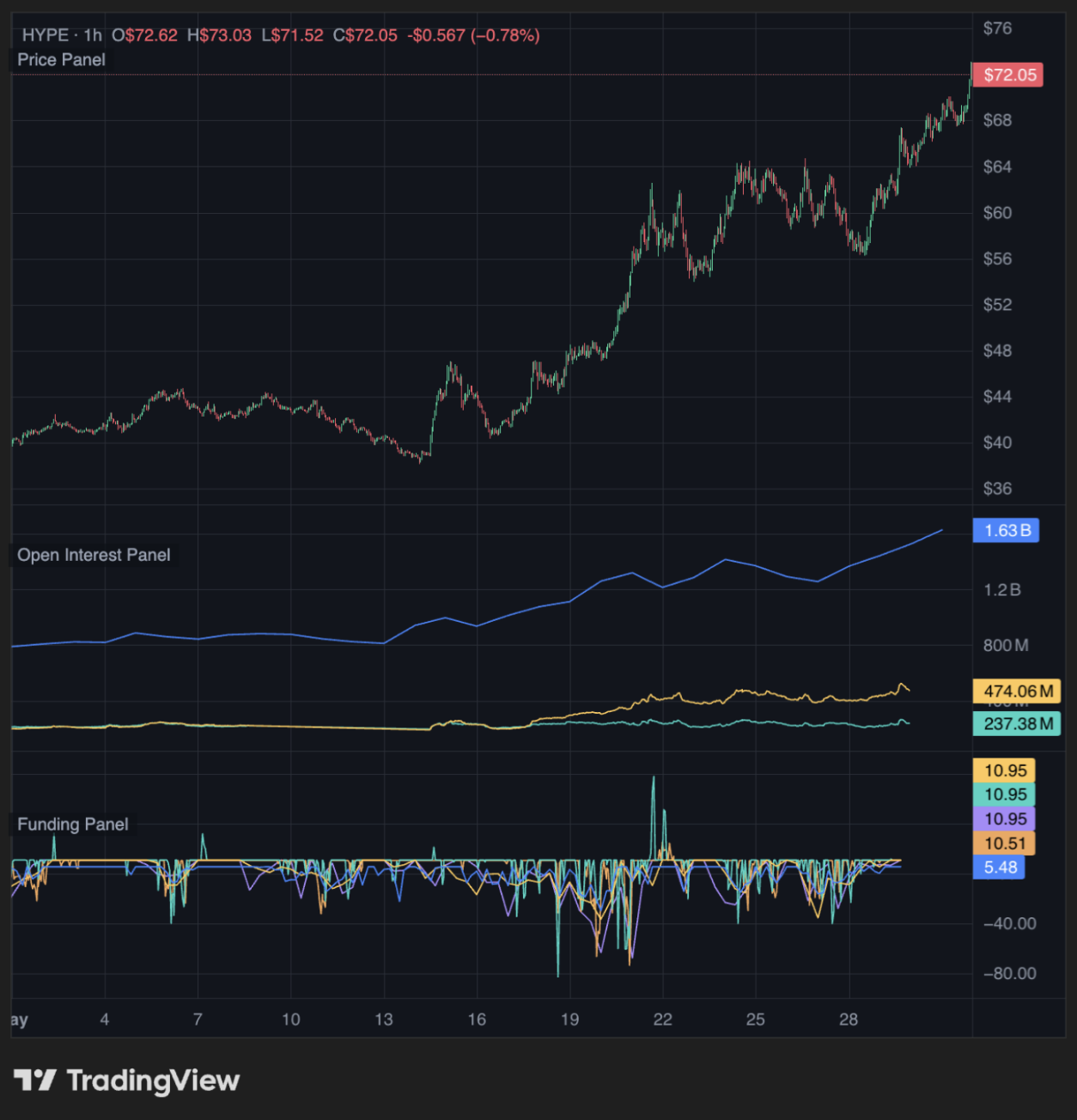
On July 27th, 2026, HYPE’s Open Interest reached a record $5.7B, while the price was stuck in a corrective range, attempting to break the $64 resistance.
Following the divergence, the market resolved bearishly. By August 19th, HYPE was trading at $58. Positioning that had accumulated through the range unwound over roughly three weeks.
Divergence tells you the market is vulnerable, not which way it breaks. Here it broke lower. The same setup with short-heavy funding would have broken the other way.

Faro can notify you on changes to open interest, price action, and funding rates for the perp markets, in real time.
Instead of watching the charts, set a Faro Open Interest alert and get notified instantly via the app, or Telegram, as soon as open interest spikes or drops – allowing you to act on trading opportunities as soon as they happen.
Set your Faro Open Interest alert
What does rising Open Interest mean?
Rising Open Interest means that the total number of active, unsettled futures and perpetual contracts between longs and shorts is increasing.
Is high Open Interest bullish or bearish?
High Open Interest doesn’t necessarily mean that the market is bearish or bullish. It shows that there are a lot of long and short side contracts being opened.
What is the difference between Open Interest and Volume?
Open Interest is how many contracts are open on the market, whereas volume means how much trading of an asset has happened.
Where can I check Hyperliquid open interest?
You can check Open Interest directly on the Hyperliquid app.
What does falling Open Interest during a rally mean?
If price is rallying while Open Interest is falling, it means that the rally is driven by more positions closing opposed to new positions being opened.

Join our 30-day trading contest and receive 30 days of Faro Pro free (worth $249), including unlimited credits and advanced market intelligence.
Not interested in the contest?