← Back to blog Faro
Faro
10 Sept 2026
Hyperliquid Funding Rates: How They Work and What Extreme Funding Signals
FaroFaro
Hyperliquid funding rates are hourly payments between long and short traders that keep a perpetual contract tied to the spot price. When the perp trades above spot, longs pay shorts. When it trades below spot, shorts pay longs.
Funding behaves like a fee, but no exchange collects it. Hyperliquid moves the payment from one side to the other and keeps nothing. The size of the payment tracks how far the perp has drifted from the oracle price, which is Hyperliquid's own spot reference, blended from prices across major exchanges.
Perpetual contracts never expire, so no settlement date forces the perp back in line. Funding does that job instead. It pays traders to take the unpopular side. Those traders buy the discount or sell the premium, and their orders pull the perp back toward the spot price.
Hyperliquid settles funding on the hour, every hour. It takes a snapshot of your position each time and moves the payment between traders. Hyperliquid facilitates the transfer but does not keep the payment and charges nothing on top.
The snapshot timing matters. If you open and close a position inside the same hour, you pay no funding at all. If you hold across the hour boundary, you pay or receive the full hourly amount on your size at that moment.
Funding cost runs separately from your trade P&L. A profitable long still pays funding when the perp trades above spot. A losing short still earns funding in the same conditions. So a winning trade can bleed funding, and a losing trade can collect it.
Rates also move sharply between hours. Funding can spike, fade, or flip sign depending on how crowded positioning gets and how volatile the hour is.
The funding rate on Hyperliquid currently sits at for BTC and for HYPE.
While most centralized exchanges settle funding every 8 hours, the funding rate on Hyperliquid settles on a predetermined hourly cadence at one eighth of the computed rate for each hour (0.01% every 8 hours, or 0.00125% every hour), with funds being added or subtracted from the balance of holders at each interval.
This funding mechanism prevents discrepancies from occurring between the perpetual contract and the underlying asset, pulling it back when the perp fluctuates too far from spot, and helping to close the gap rather than allowing it to persist for an extended period of time.
Hyperliquid’s formula: Funding Rate (F) = Average Premium Index (P) + clamp (interest rate - Premium Index (P), -0.0005, 0.0005)
When it is time to pay, Hyperliquid uses the oracle price, opposed to the mark price, to size the payment. This keeps it tied to a market reference that is harder to manipulate rather than the exchange’s own contract price.
So we know how Hyperliquid calculates funding. What does it actually cost?
A positive funding rate is a direct cost for a long. At each hourly settlement, the long pays the short. Or vice versa for a negative funding rate.
Let's break down the following example. Take a $10,000 BTC long, held unchanged. On a typical day, BTC funding could be at 0.0025% per hour:
Funding payment = 10,000 × 0.0025% = $0.25 per hour, which translates to:
The funding rate is not fixed. It moves with positioning. Here’s what the same $10,000 BTC long pays across the range:
Every payment comes out of your account balance. Funding is not a separate bill you settle later. It debits your margin each hour, which is worth monitoring as it can push your liquidation price closer to the market price.
Leverage does not change the funding cost. It only changes the margin supporting the exposure. Hold that $120 daily bill against $10,000 of margin and it costs 1.2% of your margin per day. But if you hold the same position on $500 of margin it costs 24% per day.
To read funding as a signal, traders often combine it with open interest. This is the total value of open positions open in the market. Rising open interest means traders are adding. Falling means they are closing.
There are two regimes that traders typically read as a signal for extreme funding:
In the middle is neutral funding, where the rate holds near zero, or only slightly positive or negative. Neither side is paying much to hold its position, so no squeeze fuel is building. Price moves in this regime tend to come from spot flow rather than from forced liquidations.
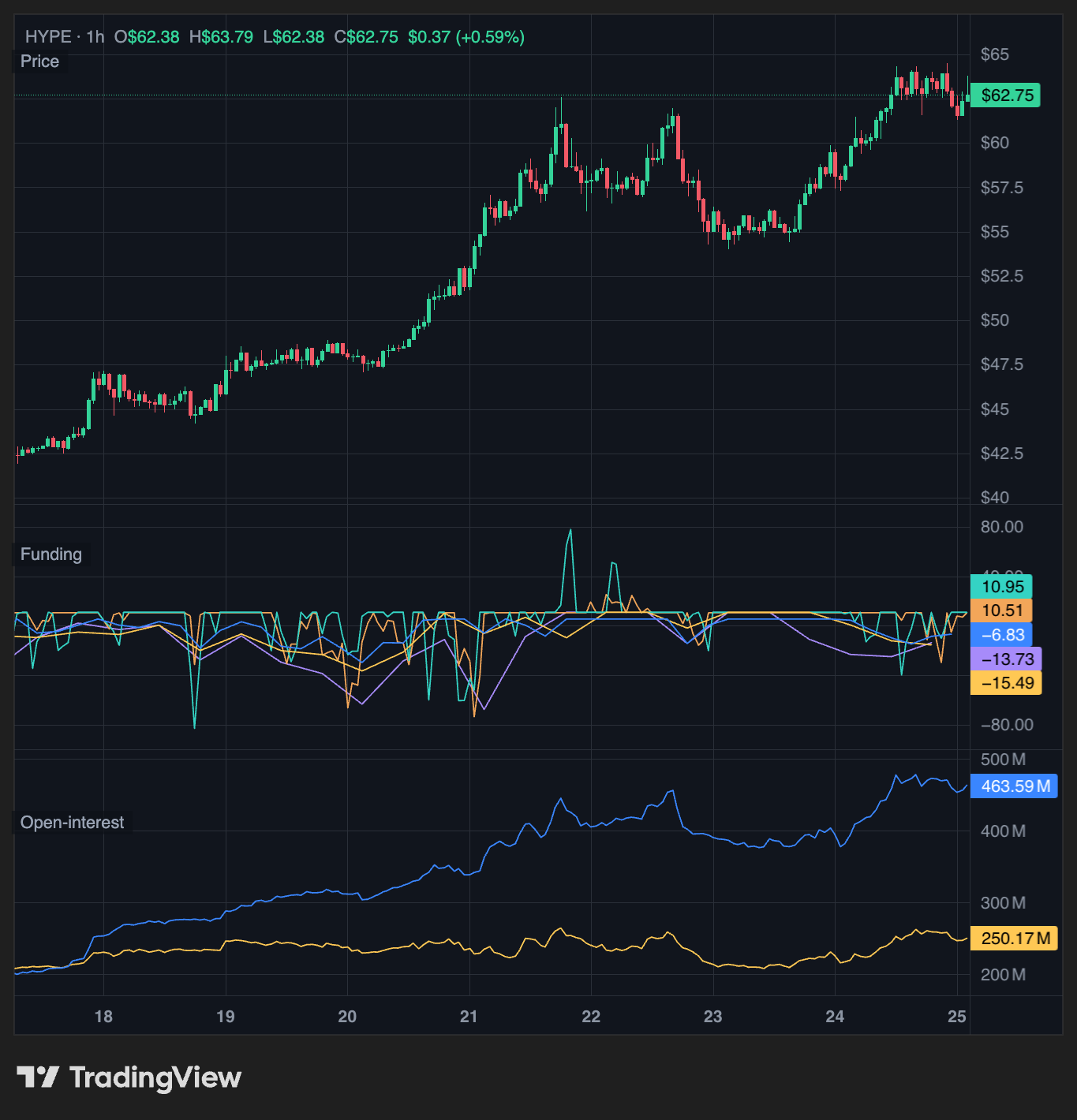
On May 18th, 2026, traders built up their short positions in HYPE as funding rates turned negative due to a wave of liquidations.
Over the next 24hrs, short positions saw $30.66M in liquidations, and a further $1.08M in longs, with open interest exceeding $2.5B. Come May 20th, HYPE then reclaimed its $50 price hold for the first time in 8 months, and by the 23rd, HYPE had reached its all time high of $62, which was a ~147% year to date gain.
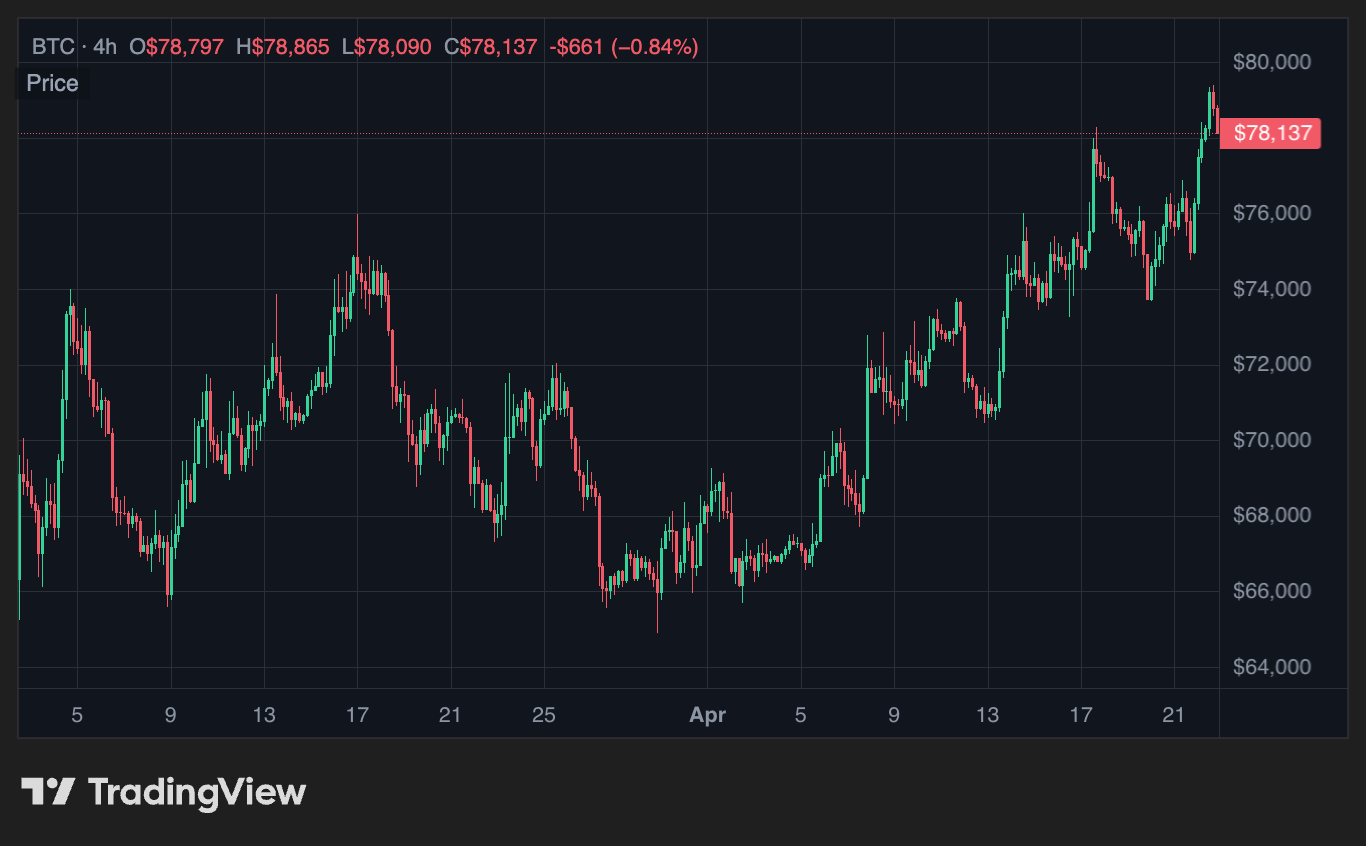
As of April 15th, 2026, BTC's 30-day average funding rate had been negative for 46 consecutive days across major derivatives venues, matching the stretch seen at the 2022 bear market bottom after the FTX collapse.
BTC briefly broke $76k during this period before falling back near $74k. Traders stayed bearish anyway. Open interest kept rising, which meant new short positions were being opened rather than existing ones closed. Rising price against rising open interest and negative funding is a classic crowded-short setup.
The squeeze arrived later in April. Strategy's $2.54B bitcoin purchase forced shorts to cover, liquidating over $427M in short positions and pushing BTC toward $80k.
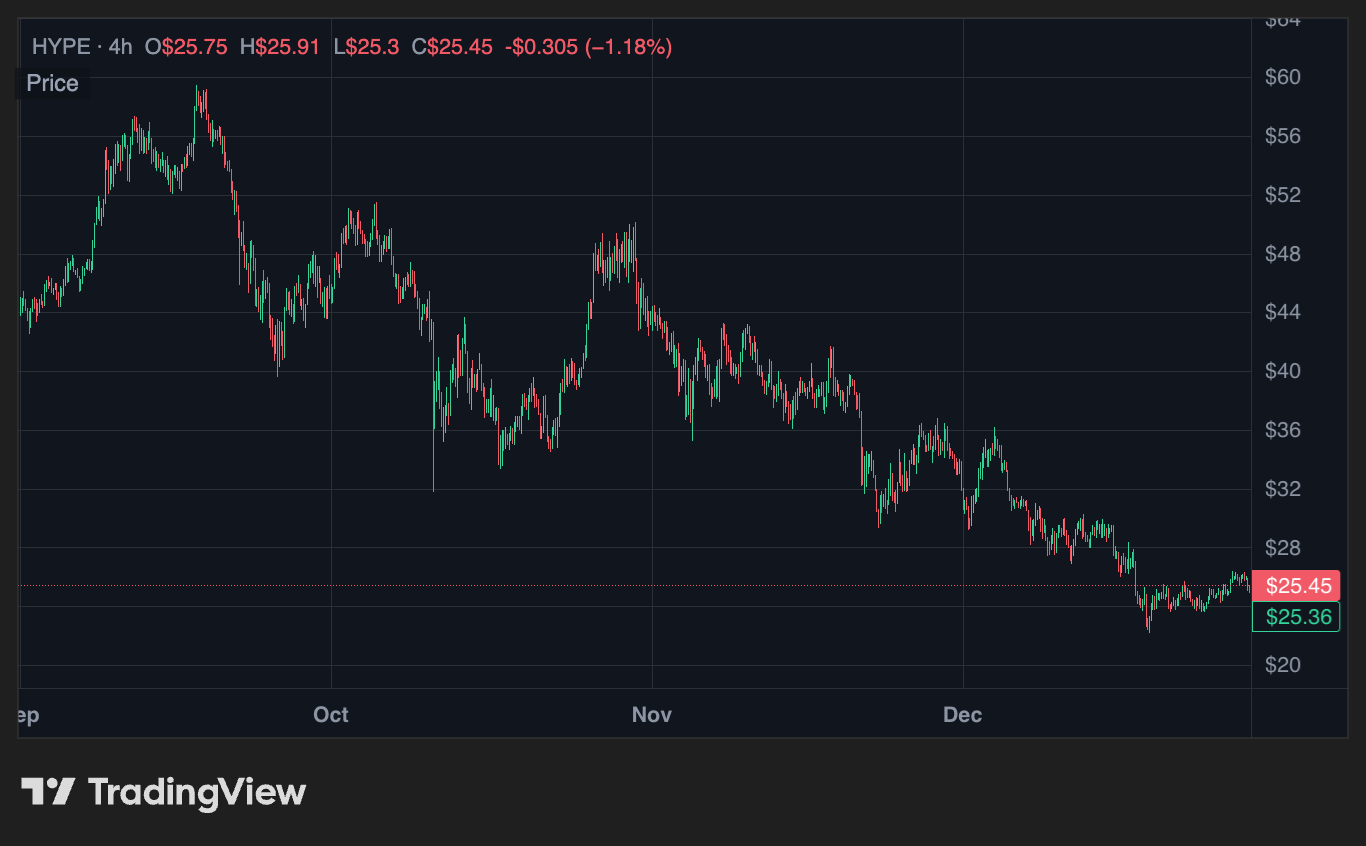
On December 17th, 2025, HYPE's funding rate spiked to 0.0839%, and open interest jumped 1.63%.
The spike followed the Hyper Foundation's proposed validator vote on the ~37M HYPE held in the Assistance Fund. The proposal did not destroy new tokens. Those tokens already sat in an address with no private key, irretrievable without a hard fork. The vote formally recognised them as burned so they would leave circulating and total supply.
The timing looked like a floor. HYPE had shed ~20% that week and was down 26.9% over 30 days and 52.8% over three months. Traders bought the news, betting the supply headline would end the downtrend. The funding spike shows exactly that: longs paying up for the privilege of being positioned for a reversal.
But the reversal did not come. HYPE bounced to $28 and was pushed back below $27 the same day. Validators approved the vote on December 24th with 85% in favour, and HYPE sat near $24, roughly 59% below its September all-time high.
This was a direct result of funding dynamics: lots of traders went long crowding into the market due to a non-event, and the unwinding of their positions through forced selling and voluntary closing accelerated the fall.
Faro can notify you on changes to funding rates, price action, and open interest for the perp markets, in real time.
Instead of watching the charts, set a Faro funding rate alert and get notified instantly via the app, or Telegram, as soon as the rates move, flip, or hit your threshold – allowing you to act on trading opportunities as soon as they happen.
Does positive funding mean longs pay shorts?
Yes, positive funding means longs pay shorts when funding settles hourly. This is due to perpetual futures trading above the spot or reference price.
How often does Hyperliquid charge funding?
Hyperliquid charges funding every hour.
What is a negative funding rate?
A negative funding rate is when shorts pay longs. This happens when the perpetual contract is trading below the spot price.
Is funding based on the mark price?
Funding payment is calculated from a traders position value which generally uses the mark price, however, when it is time to pay, Hyperliquid uses the oracle price, opposed to the mark price, to size the payment.

Join our 30-day trading contest and receive 30 days of Faro Pro free (worth $249), including unlimited credits and advanced market intelligence.
Not interested in the contest?