← Back to blog Faro
Faro
18 Sept 2026
Hyperliquid Liquidations: How Cascades Work and How to Trade Them
FaroFaroA liquidation cascade refers to a chain reaction of forced liquidations of trading positions that triggers a sudden price drop.
Hyperliquid closes a leveraged perp position when account equity falls below the maintenance margin. A liquidation cascade starts when those forced closes push price into the next cluster of liquidation prices, so each forced close triggers the next one. Long cascades drive price down, and short cascades drive price up.
This post explains the liquidation engine, the HLP backstop, and the data signals that mark the end of a cascade.
A liquidation on Hyperliquid is the forced closing of a leveraged perpetual futures (perp) position, and it happens when your account equity falls below the maintenance margin required to keep your positions open. If you are in a long position and the price falls, or in a short position and the price rises, your unrealized loss eats into your equity. Once that equity no longer meets the maintenance margin, Hyperliquid will reduce or close your position to protect itself from bad debt.
The core components to this event are account equity, maintenance margin, and margin ratio:
| State | Condition | Result |
| Healthy | Equity sits well above maintenance margin | Position stays open |
| Danger zone | Unrealized loss grows and the buffer shrinks | Liquidation price moves closer |
| Forced close | Equity falls below maintenance margin | Hyperliquid reduces or closes the position |
Hyperliquid BTC liquidations currently sit at over a 24hr window.
—
X
Hyperliquid calculates the liquidation price by determining the exact price at which your account equity can no longer satisfy the maintenance margin required to keep your position open.
Liquidations trigger off the mark price, which is not the price you see on the chart. Mark price is the median of three inputs: the oracle price plus a 150 second EMA of its gap to Hyperliquid's mid price, the median of best bid, best ask and last trade on Hyperliquid, and a weighted median of perp mid prices from Binance, OKX, Bybit, Gate and MEXC. Because a thin liquidity wick only moves one of those three inputs, it will not force a liquidation on its own. The oracle price is a separate thing. Validators publish it every three seconds from CEX spot prices, and it drives funding rather than liquidations.
The starting point for the threshold is maintenance margin by margin tier. Hyperliquid sets maintenance margin at half the initial margin at the asset's max leverage, and the rate comes from the margin tier your notional falls into, so larger positions carry a higher rate. That works out to roughly 1.25% of your position at a 40x tier, and up to roughly 17% at a 3x tier.
The liquidation formula published by Hyperliquid is:
liq_price = price − side × margin_available / position_size / (1 − l × side)
Side 1 is for longs, and -1 is for shorts. Position size is the size of your position in units of the asset. Margin available is your account value minus the maintenance margin required in cross mode, or your isolated margin minus the maintenance margin required in isolated mode. The l term is 1 divided by the maintenance leverage, and maintenance leverage is twice the asset's max leverage, so l is the same maintenance margin rate described above.
Cross liquidation price is independent of the leverage you choose, and depends instead on your total account equity. Isolated leverage works differently, because it directly sets an allocated margin, and therefore sets the liquidation price itself.
Hyperliquid does not dump large positions on the book all at once. For liquidatable positions above 100,000 USDC, only 20% of the position is sent to the order book as a market liquidation order, rather than one large order that could use up all of the available liquidity and give the trader a worse fill.
That protection has a limit. After a block where any of your positions is partially liquidated, a 30 second cooldown starts, and during that cooldown every market liquidation order for your account is sent for the entire position. The slicing stops.
If equity keeps falling and drops below two-thirds of the maintenance margin, which could be due to a fast moving market, thin liquidity, or a concentrated position, the process shifts from the order book to a backstop. The remaining position transfers directly to the HLP liquidator vault, which takes it over at a mark based price and unwinds it itself.
The backstop is where it gets expensive. On a normal close through the book, any leftover collateral is returned to you. In a backstop liquidation, the maintenance margin is not returned, and that buffer becomes HLP's edge for taking on the position.
Your margin mode decides how far the damage spreads. A cross backstop takes all of your cross positions and all of your cross margin, not just the position that blew up, so a trader running cross alone can end up at zero equity. An isolated backstop only touches that one position.
This structure is designed to reduce the odds of a large liquidation cascading through the book, which drags other positions down with it.
A liquidation cascade is a forced deleveraging feedback loop where price moves enough that one forced close triggers the next. These forced closes add more market selling and buying, with the extra pressure then pushing price into the next cluster of liquidations.
In a long liquidation cascade, leveraged longs are forcibly closed as price falls. The engine closes those positions into the market, adding downside pressure and potentially triggering more long liquidations. In a short liquidation cascade, the opposite happens: price rises, shorts are forced to buy back, and that buying can push higher into even more short liquidations.
The market impact from closing positions is what causes the damage, and it is also why Hyperliquid slices large liquidations and hands the remainder to HLP. That design damps the loop inside the venue, though it does not stop price moving across the wider market.
There are three signal patterns that traders read that directly correspond to a trigger condition:
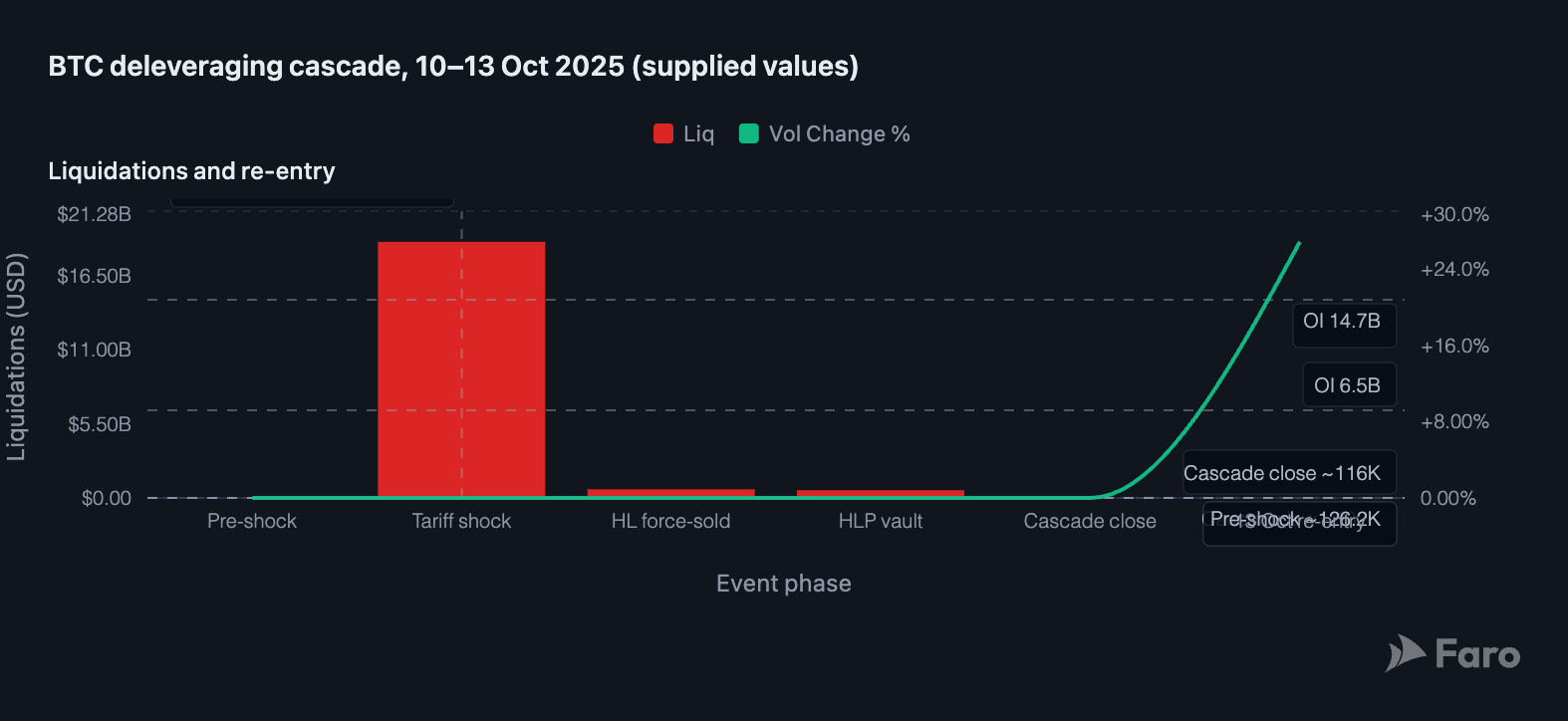
On October 10th, 2025 crypto was sitting at a record-high open interest and crowded long positioning. Open interest on Hyperliquid was at $14.7B, with BTC trading near its all-time high of $126K. That evening, Trump announced 100% tariffs on Chinese imports which led to open interest falling to $6.5B, a 56% collapse. Liquidation volume across the market hit $19B, the largest deleveraging event to be recorded as of today.
The market unwind continued, and a few hours later roughly $641M was force sold on Hyperliquid, with $576M of it routed to the HLP liquidator vault at the peak of the panic. BTC bottomed to near $102K before closing the cascade event around $116K.
By October 13th, the liquidation split had turned in favour of shorts, with the 24hr volume up 26.8% as previously liquidated traders re-entered the market.
1. At what price does Hyperliquid liquidate my position?
Hyperliquid liquidates your position at the mark price where your account equity no longer covers the maintenance margin required.
Hyperliquid publishes the formula as liq_price = price − side × margin_available / position_size / (1 − l × side), where side is 1 for longs and -1 for shorts, and l is 1 divided by twice the asset's max leverage.
2. Does Hyperliquid charge a liquidation fee?
No, unlike most exchanges Hyperliquid does not charge a clearance fee on liquidations. There is still a cost though. If your position closes on the order book, any remaining collateral stays with you, but in a backstop liquidation through the HLP vault the maintenance margin is not returned.
3. What is a liquidation cascade?
A liquidation cascade is a forced deleveraging feedback loop where one forced close pushes price into the next cluster of liquidations, which triggers the next close. Long cascades drive price down and short cascades drive price up.
4. Does cross or isolated margin change what happens when I get liquidated?
Yes, and it changes how far the damage spreads. A cross backstop liquidation takes all of your cross positions and all of your cross margin, not just the position that triggered it. An isolated backstop only touches that one position and its allocated margin.
5. What is the HLP liquidator vault?
The HLP liquidator vault is a component strategy of Hyperliquid's HLP vault, and it acts as the backstop counterparty when the order book cannot absorb a liquidation. It takes the position over at a mark based price and unwinds it. The PnL from those liquidations goes to HLP depositors rather than to the exchange.

Join our 30-day trading contest and receive 30 days of Faro Pro free (worth $249), including unlimited credits and advanced market intelligence.
Not interested in the contest?