← Back to blog Faro
Faro
22 Sept 2026
Is HYPE still undervalued?
FaroFaroAnyone telling you $HYPE is obviously cheap is missing something.
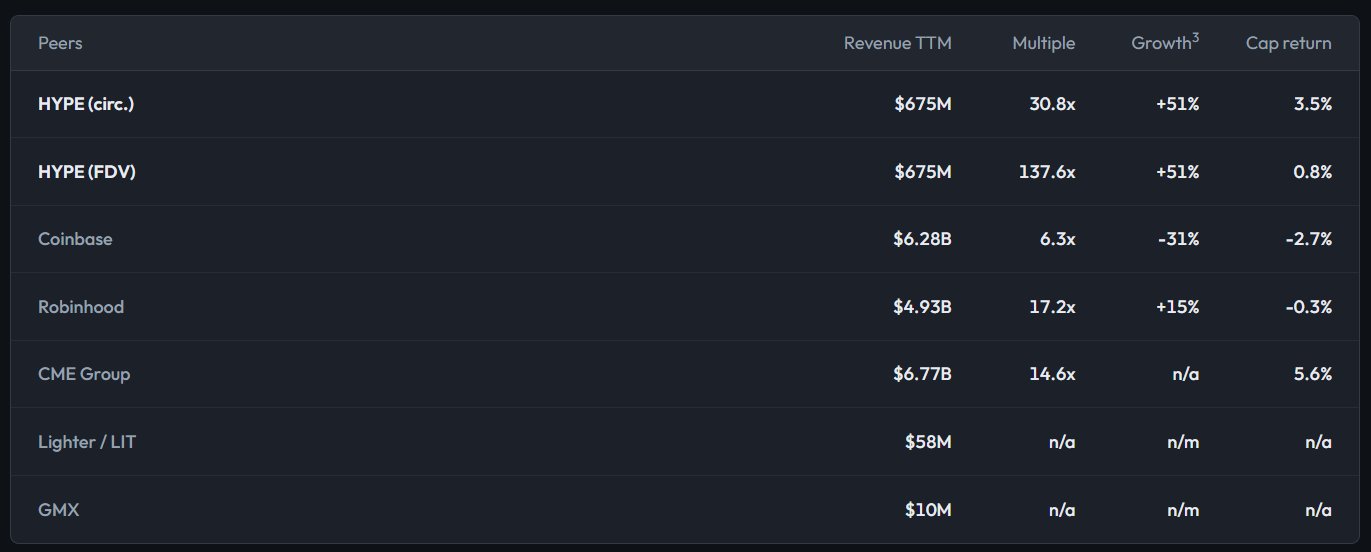
Compared to some of its peers, it looks expensive at first glance, trading at 30.8x TTM revenue on circulating supply, and 139.3x on fully diluted supply.
CME, a mature, dominant derivatives exchange with a clearing monopoly and a century of history, trades at 14.6x EV/revenue, while Robinhood is similar at 21.8x, and Coinbase trades way down at 8.2x.*
HYPE is way above all of them measured on circulating supply, and on fully diluted it is not even in the same conversation.
But while a revenue multiple tells you what a business takes in. It tells you nothing about what makes Hyperliquid different as an investment proposition. Here are a few things it misses:
For Hyperliquid's TradFi counterparts—CME, Coinbase and Robinhood—revenue multiples and what reaches the stock are very different numbers. But for Hyperliquid they are almost the same.
A listed exchange spends most of its revenue before a stock holder sees any of it. Between staff, compliance, tax and other expenditure, CME converts roughly 58% of revenue into profit, and that is best in class.
Meanwhile, Hyperliquid routes 97-98% of protocol revenue straight into buybacks. A dollar of HYPE revenue is nearly a dollar returned to token holders. This is the work of the Assistance Fund, an on-chain wallet that takes almost every fee Hyperliquid earns and automatically converts it into HYPE. Cumulatively it has bought $1.11B on the open market, with more returned through burns from priority fees, HIP-3 and spot.
The revenue multiple doesn't measure this yield, but if we price it in, then the comparison with TradFi counterparts flips on its head.
As the Yield Lens shows, HYPE returns 3.5% of circulating market cap, measured as trailing 30-day buybacks against market cap at time of writing. The S&P 500 pays 1.8%, but that is dividends. Coinbase returns -0.4%, because it issues more stock than it retires. On a fully diluted basis HYPE still returns 0.8%. HYPE stands out as the only one that buys itself.

Every $1 of trailing annual revenue costs $8.20 at Coinbase, $21.80 at Robinhood, $17.60 at CME, and $30.80 at HYPE.
Over the same twelve months, Coinbase's revenue fell 17%. Robinhood's grew 32%, while CME's grew 7%, and Hyperliquid's grew 51%, on a $675M base.*
As is the norm in equity markets, you pay more for what is growing: Coinbase is cheap because it is shrinking, CME is priced for stability, but Hyperliquid is compounding faster than any of them.
Perps are the business today, but the business being built covers the entire House of Finance vision. Spot, HIP-3 markets and everything on HyperEVM feed the same fee and buyback engine, creating a much wider business than just the perps venue.
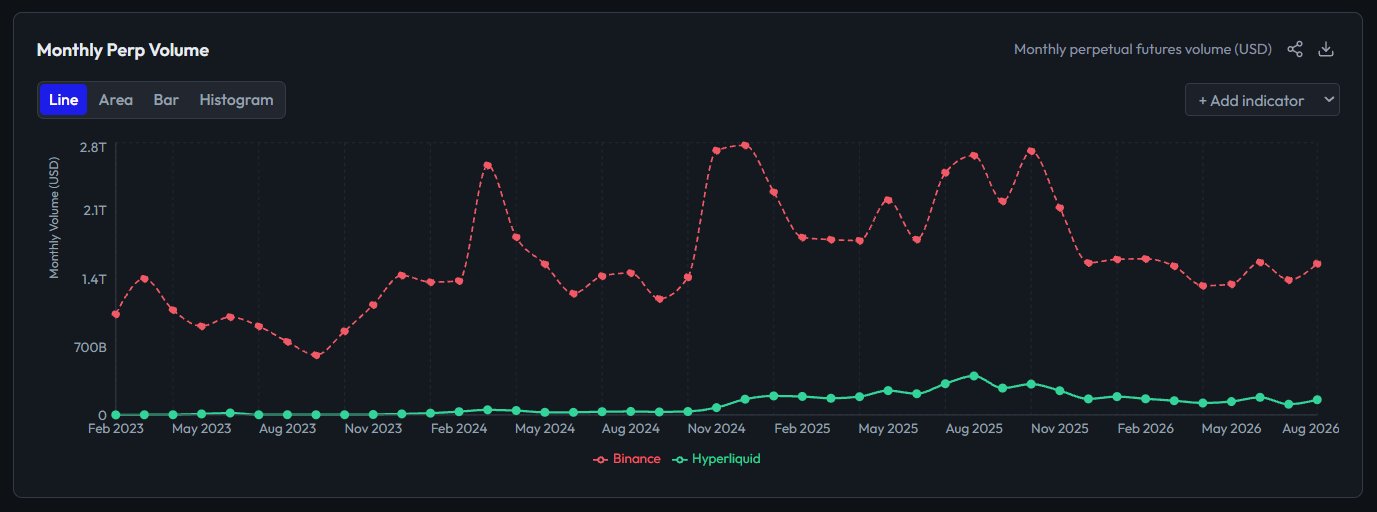
But even taking this narrow vision, if we assume that Binance is the ceiling for perps, there is still a long way to run: Binance did about $1.6T in perp volume last month, while Hyperliquid did about $170B — roughly 11% share, up from near zero three years ago.
Only around 22.2% of the max HYPE supply currently circulates.
The rest vests into 2027-28, and based on the amount that is scheduled to be unlocked, buybacks absorb very little of it.
This is shown on the HYPE dashboard in the current absorption ratio measured with scheduled unlocks, which shows only 7% of the unlocked supply is absorbed by the buybacks over the trailing 30 days.

However, measured against what holders actually claimed on-chain, buybacks absorb 144%.

Of course, unclaimed tokens are still owed. A holder who has waited two years might claim tomorrow, but pricing HYPE off the scheduled number alone leads to the wrong conclusion.
While claims stay below the scheduled amounts, the supply overhang is hypothetical. But if claims catch up to it, the bear case becomes much more realistic.
The buyback also carries its own risk. The Assistance Fund routes fees to HYPE because the team chose that, but no contract requires the Assistance Fund to route fees to HYPE, and holders have no recourse if the policy changes. Nothing suggests it will, but it is not like a dividend that is declared and legally owed.
Furthermore, the yield is a function of cyclical volume: a 3.5% return measured on trailing 30-day buybacks assumes the last 30 days repeat, and in quiet markets perp volume falls, sending revenue and buybacks lower too. The current yield and the growth rate are based on a strong twelve months of performance.
Beyond those risks, the standard list applies: Hyperliquid has strong competitors that could be subsidised, and it may be subject to regulatory exposure wherever perps get attention. Realistically, none of these can be priced with much precision, which is part of why the range of analyst price targets is so wide.
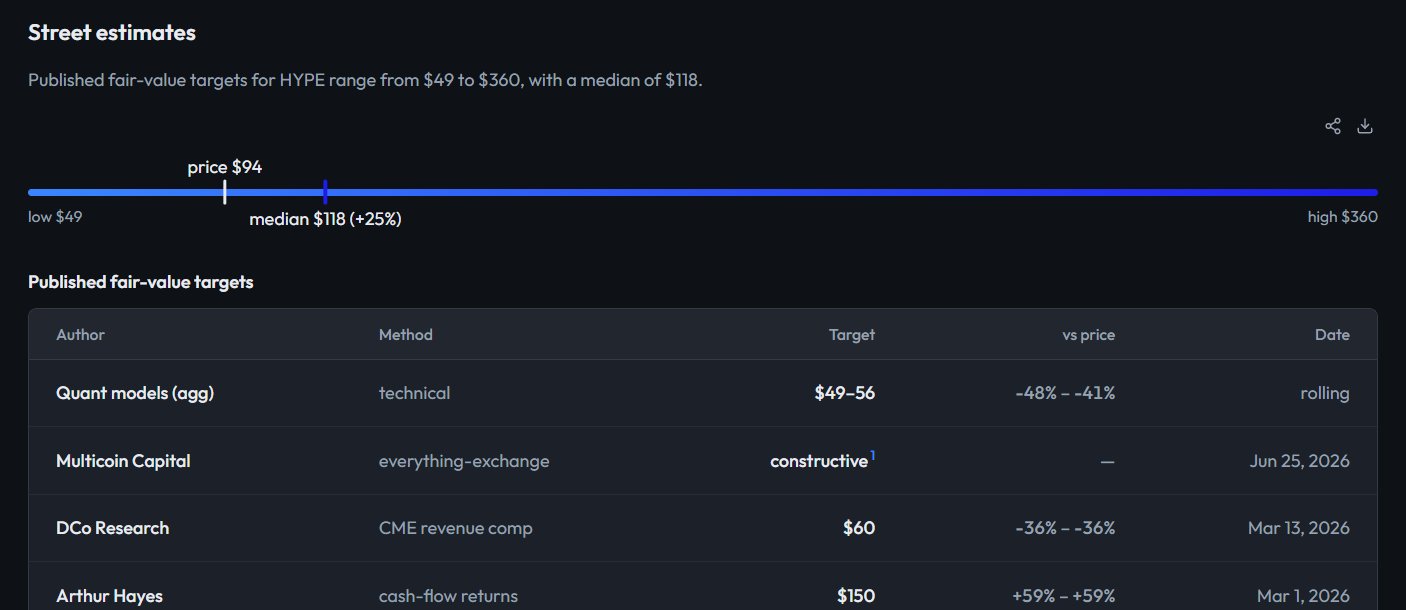
The analyst view on HYPE is far from consensus, with published fair-value targets ranging from a low of $49 to a high of $360. The median is $118, which is 26% above spot at the time of writing.
See all the data for yourself on the Faro HYPE dashboard, and make up your own mind whether HYPE is undervalued.
*Peer figures are EV/revenue. HYPE is market cap/revenue, as there is no debt or cash balance to adjust for.

Join our 30-day trading contest and receive 30 days of Faro Pro free (worth $249), including unlimited credits and advanced market intelligence.
Not interested in the contest?